
‘Article 36’ weapons reviews
The United Kingdom is legally obliged to ensure that all weapons and associated equipment that it obtains, plans to acquire, or develops comply with the UK’s treaty and other obligations under International Humanitarian Law (specifically Article 36 of The First Protocol of 1977 Additional to the Geneva Conventions of 1949). MOD Article 36 reviews are conducted by the Legal Team at the Development, Concepts and Doctrine Centre (DCDC) at Shrivenham.
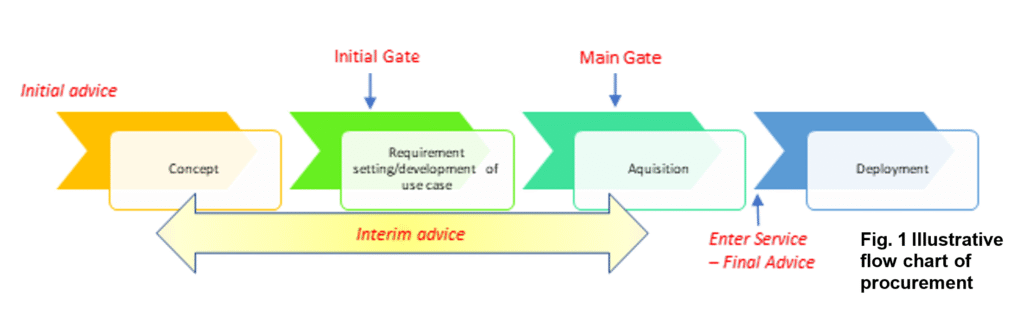
Legal reviews are part of the ‘critical path’ for Defence capability development and must be undertaken at key milestones during the procurement lifecycle, including: the decision to commit funds to developing a capability (known as ‘Initial Gate’); the decision to commit to the procurement of a particular piece of equipment or weapon (known as ‘Main Gate’); and at the date the finalised equipment enters service. In addition, a weapon system will become subject to further review during its life cycle where it undergoes significant modification. The result is that a weapon incapable of complying with IHL will never enter the UK inventory for use in armed conflict. In practice, reviews are increasingly iterative throughout the procurement lifecycle. While the precise requirements will inevitably differ from case to case (making it impossible to suggest an indicative timeline), in essence the lawyer will need to engage a wide group of experts to understand, in some detail, what the equipment is, what it is designed to do, how it does it and what its effect is. Urgent Operational Requirements (UORs) are also subject to this legal review process, though such weapons can be very rapidly reviewed provided the necessary performance information is available. Likewise, when the UK seeks to acquire equipment that is already in service with another State, the UK is nevertheless legally obliged to conduct its own legal review. (Fig. 1, above).
Reviews themselves, as noted above, will vary in structure according to the particulars of each case, but all serve the same core purpose: to ensure that the weapon is capable of being used lawfully, having regard to all of the principles of IHL, in the context of its use case. A general outline of process requires a review to:
(1) Be conducted by the DCDC legal team (featuring a lawyer from the Navy, Army and RAF — thus covering all domains — each of whom is an IHL specialist);
(2) Consider prohibition or restriction of use through treaty or provision of international law;
(3) Consider capacity for discriminate use and possibility to cause unnecessary suffering or severe damage to the natural environment;
(4) Comprise expertise and intel from relevant personnel (including, for example, scientific subject matter experts, operational commands, or front line users);
(5) Be supported by relevant data such as technical descriptions, evidence of accuracy, evidence of reliability, and assessment of impact (including biomedical assessments, terminal ballistics studies and environmental assessments) where required.
The MOD is currently assessing whether the current approach to legal review of weapons requires adjustment for AI-enabled capabilities, working in collaboration with partners to identify international standards. One key point of consensus is the need for re-review if there is any material change to the performance data or the core considerations that comprise a review. The emerging consensus is that such reviews may be built into the operational maintenance of the system and conducted in a constant feedback manner to ensure rapid and agile processes that maintain legal standards.
Letter from James Cartlidge MP, the Minister of State for Defence Procurement, to Lord Lisvane, Chair, Lords Artificial Intelligence in Weapons Systems Committee (13 November 2023)